Issues of 7 for Sunday.
Issue № 142
Sight
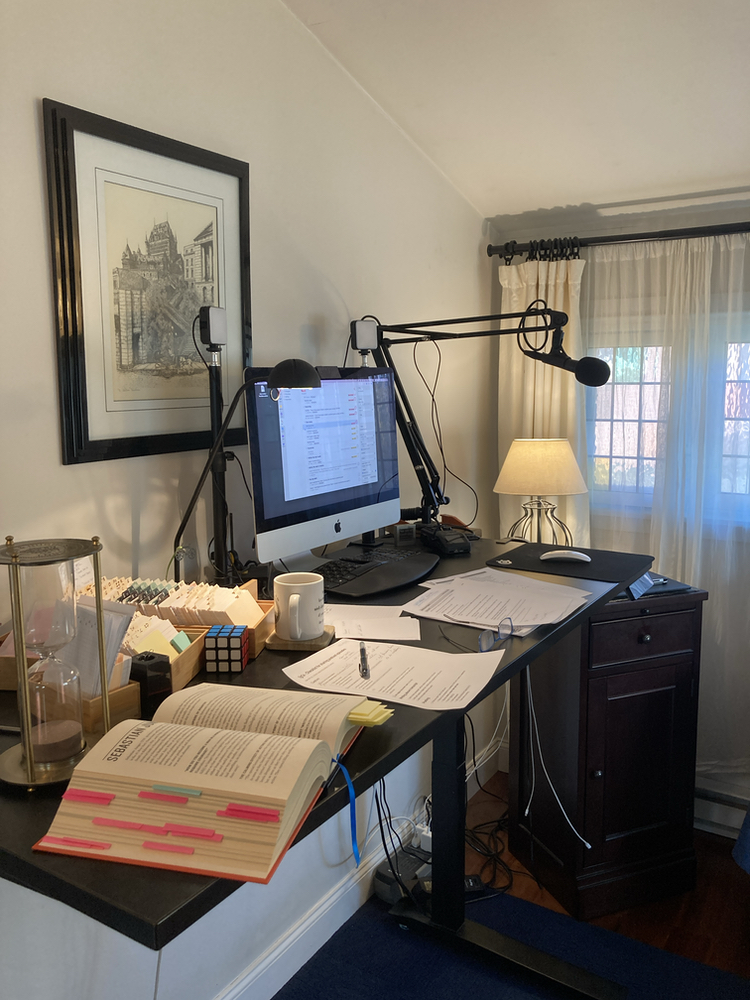
Insight is just “in sight” — and placing physical books where they can literally be seen turns out to be a deliberate way of cultivating the conditions for apprehending new ideas. Ira Glass notes that nervousness before an interview is a sign of ambition, a sign that you know how hard it might be to get it to work. The insight not yet achieved: how to feel that what’s been done so far, and what’s being done now, is enough.
Issue № 141
Acceptance
The more you listen — truly listen, without the implicit threat of interruption — the more someone becomes a self-discoverer right there in the conversation, growing more confident in their own exploration. That quiet, profound effect threads through an issue about acceptance: Stoic joy arising from good conduct rather than good outcomes, Michael J. Fox’s happiness growing in proportion to acceptance and inverse proportion to expectations, and a mountain ascent in northern Japan that became a pilgrimage without intending to.

Issue № 140
Eudaimonia
Each night, closing eyes toward sleep, the question that surfaces without choosing to ask it: if that was the last day of my life, am I satisfied with what I did? The issue circles eudaimonia — that word we don’t have in English, possibly because we don’t think about it enough, possibly because we don’t think about it enough because we lack the word — and arrives at Hugh MacLeod’s flawed but illuminating definition: art is that which you have no choice but to do, because your soul demands it.
Issue № 139
Personal progress
Dinner resists optimization — it will always be a grind, as unrelenting as breathing, and there’s freedom in surrendering to that. That insight anchors an issue asking where real progress actually appears: not in grand plans, but right at the point of overwhelm, where something finally breaks down and simplifies. Studying your own history turns out to be more useful than studying humanity’s, because the questions you can ask of yourself are so much more answerable.
Issue № 138
The courage to wait
David Lynch’s Twin Peaks had a third season — which gets discovered mid-article, mid-read, and everything stops. The issue circles the experience of waiting: the blissful serenity that occasionally appears when you stay perfectly still long enough to wonder if the next thought is really worth getting up for. Posterity, Maria Popova predicts, will be gobsmacked that we put ourselves through the agony of the three pulsating dots.
Issue № 137
This is enough
After a lifetime of seeking — knowledge, control, achievement, clarity — the realization that life is not about seeking at all, but about noticing what’s already here. Lovecraft’s truth-seekers get their minds shattered by what’s on the other side of the hill; Epictetus asks why an athlete would weep in the stadium because he isn’t practicing outside anymore. It takes courage, it turns out, to simply relax and save yourself.
Issue № 136
In search of meaning
The more you learn, the less sure you become of what you thought you already knew — which turns out not to be a failure but a sign of progress. James Austin’s description of the rare moments when the mind does something amazing, moments that inspired our major religions, floats through an issue about the gap between the words we produce and the meaning we’re trying to pack into them. One must have a practice, because the alternative is to aimlessly wander.
Issue № 135
Cherishing dignity
Viktor Frankl’s distinction — between being valuable in the sense of dignity and being valuable in the sense of usefulness — has seeped in over years and now shapes how every interaction is entered. The issue tugs on the thread of dignity through data, privacy, personhood, and the difference between “can” and “should,” arriving at a simple practice: say thank you because you’re honestly grateful, and let go of small things because you’re honestly forgiving.
Issue № 134
Festina lente
Rilke asks us to love the questions themselves, as if they were locked rooms — because you cannot live the answers yet, only live your way toward them. The issue holds that alongside festina lente, Marcus Aurelius’s still-striking 2,000-year-old notes to himself, and a quietly profound observation about paper: writing is patience made physical, because you have to hold one thought clearly in mind for ten seconds to get it onto the page.
Issue № 133
Motivation is only the beginning
Discovery, reflection, efficacy — and motivation, habits, processes — the issue maps two frameworks onto each other and finds they’re really the same terrain. The most powerful motivations appear when we discover a new-to-us trait: not something to fix, but something we didn’t know we could become. Read carefully, out loud, letting each punctuation mark do its work: “I could be that?” “I could be that.” “I could be that!”